


Shoulder arthroscopy
SLAP repair; SLAP lesion; Acromioplasty; Bankart repair; Labral repair; Bankart lesion; Shoulder repair; Shoulder surgery; Rotator cuff repair; Shoulder stabilizationShoulder arthroscopy is surgery that uses a tiny camera called an arthroscope to examine or repair the tissues inside or around your shoulder joint. The arthroscope is inserted through a small cut (incision) in your skin.
Description
The rotator cuff is a group of muscles and their tendons that form a cuff over the shoulder joint. These muscles and tendons hold the arm in the shoulder joint. This also helps the shoulder move in different directions. The tendons in the rotator cuff can tear when they are overused or injured.
You will likely receive general anesthesia for this surgery. This means you will be asleep and unable to feel pain. Or, you may have regional anesthesia. Your arm and shoulder area will be numbed and as a result, you do not feel any pain. If you receive regional anesthesia, you will also be given medicine or general anesthesia to make you very sleepy during the operation.
General anesthesia
General anesthesia is treatment with certain medicines that puts you into a deep sleep-like state so you do not feel pain during surgery. After you ...
During the procedure, the surgeon:
- Inserts the arthroscope into your shoulder through a small incision. The scope is connected to a video monitor in the operating room.
- Inspects all the tissues of your shoulder joint and the area above the joint. These tissues include the cartilage, bones, tendons, and ligaments.
- Repairs any damaged tissues. To do this, your surgeon makes 1 to 3 more small incisions and inserts other instruments through them. A tear in a muscle, tendon, or cartilage is fixed. Any damaged tissue is removed.
Your surgeon may do one or more of these procedures during your operation:
Rotator cuff repair:
- The edges of the tendon are brought together. The tendon is attached to the bone with sutures.
- Small rivets (called suture anchors) are often used to help attach the tendon to the bone.
- The anchors can be made of metal, plastic, or suture material alone. They do not need to be removed after surgery.
- The sutures are usually non dissolvable.
Surgery for impingement syndrome:
- Damaged or inflamed tissue is cleaned out in the area above the shoulder joint.
- A ligament called the coracoacromial ligament may be cut.
- The underside of a bone called the acromion may be shaved. A bone spur there can cause inflammation and pain in your shoulder.
Surgery for shoulder instability:
- If you have a torn labrum, the surgeon will repair it. The labrum is the cartilage that lines the rim of the shoulder joint.
- Ligaments that attach to this area will also be repaired.
- The Bankart lesion is a tear on the labrum in the lower part of the shoulder joint that happens with dislocation. It can involve part of the glenoid bone where it can be broken off.
- A SLAP lesion involves the labrum and the ligament on the top part of the shoulder joint.
At the end of the surgery, the incisions will be closed with stitches and covered with a dressing (bandage). Most surgeons take pictures from a video monitor during the procedure to show you what they found and the repairs that were made.
Your surgeon may need to do open surgery if there is a lot of damage. Open surgery means you will have a large incision so that the surgeon can get directly to your bones and tissues.
Why the Procedure Is Performed
Arthroscopy may be recommended for these shoulder problems:
- A torn or damaged cartilage ring (labrum) or ligaments
- Shoulder instability, in which the shoulder joint is loose and slides around too much or becomes dislocated (slips out of the ball and socket joint)
- A torn or damaged biceps tendon
- A torn rotator cuff
- A bone spur or inflammation around the rotator cuff
- Inflammation or damaged lining of the joint, often caused by an illness, such as rheumatoid arthritis
Rheumatoid arthritis
Rheumatoid arthritis (RA) is a disease that leads to inflammation of the joints and surrounding tissues. It is a long-term disease. It can also aff...
 ImageRead Article Now Book Mark Article
 - Arthritis of the end of the clavicle (collarbone)
- Loose tissue that needs to be removed
- Shoulder impingement syndrome, to make more room for the shoulder to move around
Risks
Risks of anesthesia and surgery in general are:
- Allergic reactions to medicines
Allergic reactions
Allergic reactions are sensitivities to substances called allergens that come into contact with the skin, nose, eyes, respiratory tract, and gastroin...
 ImageRead Article Now Book Mark Article
 - Breathing problems
Breathing problems
Breathing difficulty may involve:Difficult breathing Uncomfortable breathingFeeling like you are not getting enough air
 ImageRead Article Now Book Mark Article
 - Bleeding, blood clots, infection
Blood clots
Blood clots are clumps that occur when blood hardens from a liquid to a solid. A blood clot that forms inside one of your veins or arteries is calle...
 ImageRead Article Now Book Mark Article
Risks of shoulder arthroscopy are:
- Shoulder stiffness
- Failure of the surgery to relieve symptoms
- Failure of the repair to heal
- Weakness of the shoulder
- Blood vessel or nerve injury
- Damage to the cartilage of shoulder (chondrolysis)
Before the Procedure
Tell your surgeon or nurse if:
- You are or could be pregnant
- You are taking any medicines, including medicines, drugs, supplements, or herbs you bought without a prescription
- You have been drinking a lot of alcohol, more than 1 or 2 drinks a day
Planning for your surgery:
- If you have diabetes,heart disease, or other medical conditions, your surgeon may ask you to see your health care provider who treats you for these conditions.
Diabetes,
Diabetes is a long-term (chronic) disease in which the body cannot regulate the amount of sugar in the blood.
 ImageRead Article Now Book Mark Article
Heart disease,
Coronary heart disease is a narrowing of the blood vessels that supply blood and oxygen to the heart. Coronary heart disease (CHD) is also called co...
 ImageRead Article Now Book Mark Article
 - If you smoke, it's important to cut back or quit. Smoking can slow healing and increase the risk for blood clots. Ask your provider for help quitting smoking.
Smoking can slow healing and increase t...
Quitting smoking and other nicotine products, including e-cigarettes, before surgery can improve your recovery and outcome after surgery. Most people...
 ImageRead Article Now Book Mark Article
Quitting smoking
There are many ways to quit smoking. There are also resources to help you. Family members, friends, and co-workers may be supportive. But to be su...
ImageRead Article Now Book Mark Article - If needed, prepare your home to make it easier to recover after surgery.
Prepare your home
Getting your home ready after you have been in the hospital often requires some preparation. Set up your home to make your life easier and safer when...
Read Article Now Book Mark Article - Ask your surgeon if you need to arrange to have someone drive you home after your surgery.
During the week before your surgery:
- You may be asked to temporarily stop taking medicines that keep your blood from clotting. These medicines are called blood thinners. This includes over-the-counter medicines and supplements such as aspirin, ibuprofen (Advil, Motrin), naproxen (Naprosyn, Aleve), and vitamin E. Many prescription medicines are also blood thinners.
- Ask your surgeon which medicines you should still take on the day of your surgery.
- Let your surgeon know about any illness you may have before your surgery. This includes COVID-19, a cold, flu, fever, herpes outbreak, or other illness. If you do get sick, your surgery may need to be postponed.
COVID-19
Coronavirus disease 2019 (COVID-19) is a respiratory illness that causes fever, coughing, and shortness of breath, but many other symptoms can occur....
 ImageRead Article Now Book Mark Article
Cold
The common cold most often causes a runny nose, nasal congestion, and sneezing. You may also have a sore throat, cough, headache, or other symptoms....
 ImageRead Article Now Book Mark Article
Flu
The flu (influenza) is a viral respiratory illness that causes fever, chills, runny nose, body aches, and cough. It spreads easily from person to pe...
 ImageRead Article Now Book Mark Article
On the day of surgery:
- Follow instructions about when to stop eating and drinking.
- Take any medicines you're asked to take with a small sip of water.
- Follow instructions on when to arrive at the hospital. Be sure to arrive on time.
After the Procedure
Follow any discharge and self-care instructions you are given.
Discharge and self-care instructions
You had shoulder surgery to repair the tissues inside or around your shoulder joint. The surgeon may have used a tiny camera called an arthroscope t...

Recovery can take 1 to 6 months. You will probably have to wear a sling for the first week. If you had a lot of repair done, you may have to wear the sling longer.
You may take medicine to control your pain.
When you can return to work or play sports will depend on what your surgery involved. It can range from 1 week to several months.
Physical therapy may help you regain motion and strength in your shoulder. The length of therapy will depend on what was done during your surgery.
Outlook (Prognosis)
Arthroscopy often results in less pain and stiffness, fewer complications, a shorter (if any) hospital stay, and faster recovery than open surgery.
If you had a repair, your body needs time to heal, even after arthroscopic surgery, just as you would need time to recover from open surgery. Because of this, your recovery time may still be long.
Surgery to fix a cartilage tear is usually done to make the shoulder more stable. Many people recover fully, and their shoulder stays stable. But some people may still have shoulder instability after arthroscopic repair.
Using arthroscopy for rotator cuff repairs or tendinitis usually relieves the pain, but you may not regain all of your strength.
References
DeBerardino TM, Scordino LW. Shoulder arthroscopy. In: Miller MD, Thompson SR, eds. DeLee, Drez, & Miller's Orthopaedic Sports Medicine. 5th ed. Philadelphia, PA: Elsevier; 2020:chap 39.
Phillips BB, Brolin TJ. Arthroscopy of the upper extremity. In: Azar FM, Beaty JH, eds. Campbell's Operative Orthopaedics. 14th ed. Philadelphia, PA: Elsevier; 2021:chap 52.
Shoulder arthroscopy - illustration
Shoulder arthroscopy is a type of surgery to examine or repair the tissues inside or around your shoulder joint. The procedure uses a small camera, called an arthroscope, which is inserted through a small incision. If the surgeon is going to repair the joint, small surgical instruments are also used, such as a shaver to remove unwanted tissue.
Shoulder arthroscopy
illustration
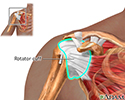
Normal rotator cuff - illustration
The rotator cuff is a group of muscles and tendons that form a cuff over the shoulder. These muscles and tendons hold the arm in its ball and socket joint and are involved in essentially all shoulder motions.
Normal rotator cuff
illustration

Shoulder arthroscopy - illustration
Shoulder arthroscopy is a type of surgery to examine or repair the tissues inside or around your shoulder joint. The procedure uses a small camera, called an arthroscope, which is inserted through a small incision. If the surgeon is going to repair the joint, small surgical instruments are also used, such as a shaver to remove unwanted tissue.
Shoulder arthroscopy
illustration
Normal rotator cuff - illustration
The rotator cuff is a group of muscles and tendons that form a cuff over the shoulder. These muscles and tendons hold the arm in its ball and socket joint and are involved in essentially all shoulder motions.
Normal rotator cuff
illustration
Review Date: 9/2/2025
Reviewed By: C. Benjamin Ma, MD, Professor, Chief, Sports Medicine and Shoulder Service, UCSF Department of Orthopaedic Surgery, San Francisco, CA. Also reviewed by David C. Dugdale, MD, Medical Director, Brenda Conaway, Editorial Director, and the A.D.A.M. Editorial team.
 All rights reserved.