


Herpes viral culture of lesion
Culture - herpes simplex virus; Herpes simplex virus culture; Herpes zoster virus cultureHerpes viral culture of a lesion is a lab test to check if a skin sore is infected with the herpes virus.
How the Test is Performed
The health care provider collects the sample from a skin sore (lesion). This is usually done by rubbing a small cotton swab on the skin lesion. Sometimes blisters may have to be opened in order to be cultured. The sample is sent to a lab. There, it is placed in a special dish (culture). It is then watched to see if the herpes simplex virus (HSV) or herpes zoster virus grow. Special tests may also be done to determine whether if a positive test is due to HSV type 1 or 2.
(lesion)
Rashes involve changes in the color, feeling or texture of your skin.

How to Prepare for the Test
The sample must be collected during the acute phase of infection. This is the worst part of an outbreak. It is also when the skin lesions are at their worst.
How the Test will Feel
When the sample is collected, you may feel an uncomfortable scraping or sticky sensation. Sometimes a sample from the throat or eyes is needed. This involves rubbing a sterile swab against the eye or in the throat.
Why the Test is Performed
The test is done to check for a herpes virus infection. Herpes simplex virus causes genital herpes. It can also cause cold sores of the mouth and lips. Herpes zoster causes chickenpox and shingles.
Genital herpes
Genital herpes is a sexually transmitted infection. It is caused by the herpes simplex virus (HSV). This article focuses on HSV type 2 infection....
Cold sores
Oral herpes is an infection of the lips, mouth, or gums due to the herpes simplex virus. It causes small, painful blisters commonly called cold sore...

Chickenpox
Chickenpox is a viral infection in which a person develops very itchy blisters all over the body. It was more common in the past. The illness is ra...

Shingles
Shingles is a painful, blistering skin rash. It is caused by the varicella-zoster virus, a member of the herpes family of viruses. This is the viru...

The diagnosis is often made by physical examination (your provider looking at the sores). The cultures and other tests are used to confirm the diagnosis.
This test is most accurate when a person is newly infected, that is, during the first outbreak.
Normal Results
A normal (negative) result means that the herpes virus did not grow in the lab dish and the skin sample used in the test did not contain any herpes virus.
Be aware that a normal (negative) culture does not always mean that you do not have a herpes infection or have not had one in the past.
What Abnormal Results Mean
An abnormal (positive) result may mean that you have an active infection with a herpes virus. Herpes virus infections include genital herpes, cold sores on the lips or in the mouth, or shingles. More blood tests will likely be needed to confirm the diagnosis or the exact cause.
If the culture is positive for herpes, you may have recently become infected. You may have become infected in the past and are currently having an outbreak.
Risks
Risks include slight bleeding or discomfort in the area where the skin was swabbed.
References
Marks JG, Miller JJ, Hollins LC. Dermatologic therapy and procedures. In: Marks JG, Miller JJ, Hollins LC, eds. Lookingbill and Marks' Principles of Dermatology. 7th ed. Philadelphia, PA: Elsevier; 2025:chap 4.
Plourde AR, Beavis KG. Specimen collection and handling for diagnosis of infectious diseases. In: McPherson RA, Pincus MR, eds. Henry's Clinical Diagnosis and Management by Laboratory Methods. 24th ed. Philadelphia, PA: Elsevier; 2022:chap 66.
Schiffer JT, Corey L. Herpes simplex virus. In: Blaser MJ, Cohen JI, Holland SM, et al, eds. Mandell, Douglas, and Bennett's Principles and Practice of Infectious Diseases. 10th ed. Philadelphia, PA: Elsevier; 2026:chap 142.
Seña AC, Swygard H, Cohen MS. Approach to the patient with a sexually transmitted infection. In: Goldman L, Cooney KA, eds. Goldman-Cecil Medicine. 27th ed. Philadelphia, PA: Elsevier; 2024:chap 264.
Whitley RJ, Gnann JW. Herpes simplex virus infections. In: Goldman L, Cooney KA, eds. Goldman-Cecil Medicine. 27th ed. Philadelphia, PA: Elsevier; 2024:chap 345.
Viral lesion culture - illustration
A viral lesion culture is performed to confirm herpes simplex virus present in a skin lesion. The specimen is collected by scraping the suspected skin lesion or aspirating fluid from the lesion. Results are available within 16 hours to 7 days of receipt of the specimen, depending on the culture method used.
Viral lesion culture
illustration
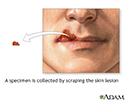
Viral lesion culture - illustration
A viral lesion culture is performed to confirm herpes simplex virus present in a skin lesion. The specimen is collected by scraping the suspected skin lesion or aspirating fluid from the lesion. Results are available within 16 hours to 7 days of receipt of the specimen, depending on the culture method used.
Viral lesion culture
illustration
Review Date: 8/18/2025
Reviewed By: LaQuita Martinez, MD, Department of Obstetrics and Gynecology, Emory Johns Creek Hospital, Alpharetta, GA. Also reviewed by David C. Dugdale, MD, Medical Director, Brenda Conaway, Editorial Director, and the A.D.A.M. Editorial team.
© 1997- A.D.A.M., a business unit of Ebix, Inc. Any duplication or distribution of the information contained herein is strictly prohibited.
 All rights reserved.