


Open gallbladder removal
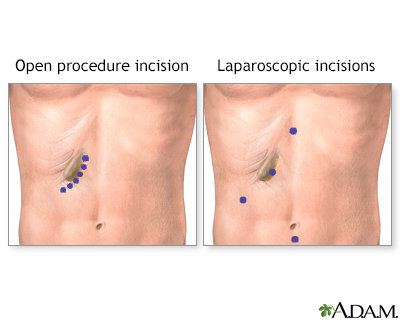
Cholecystectomy - open; Gallbladder - open cholecystectomy; Cholecystitis - open cholecystectomy; Gallstones - open cholecystectomyOpen gallbladder removal is surgery to remove the gallbladder through a large cut in your abdomen.
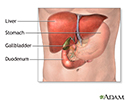
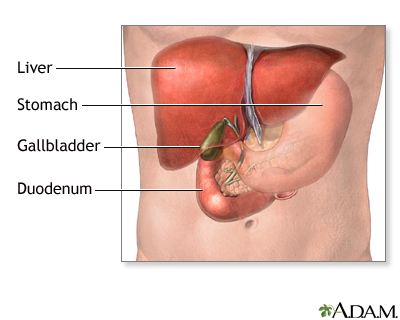
The gallbladder is an organ that sits below the liver. It stores bile, which your body uses to digest fats in the small intestine.
Description
Surgery is done while you are under general anesthesia so you will be asleep and pain-free. To perform the surgery:
General anesthesia
General anesthesia is treatment with certain medicines that puts you into a deep sleep-like state so you do not feel pain during surgery. After you ...
- Your surgeon makes a cut in the upper right part of your belly, just below your ribs.
- The area is opened up so your surgeon can view the gallbladder and separate it from the liver.
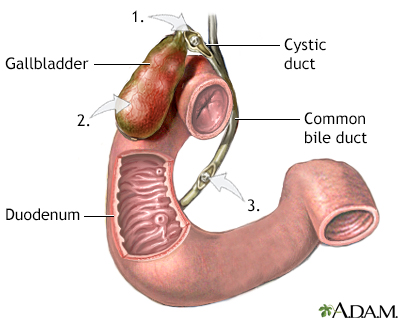
- Your surgeon cuts the cystic duct and blood vessels that lead to the gallbladder.
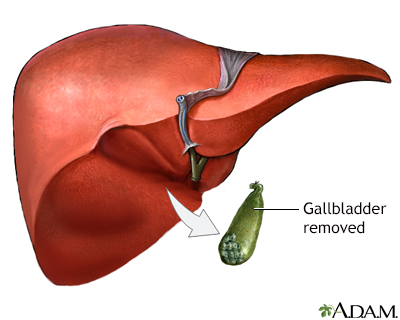
- The gallbladder is lifted out and removed from your body.
An x-ray called a cholangiogram may be done during your surgery.
Cholangiogram
A percutaneous transhepatic cholangiogram (PTC) is an x-ray of the bile ducts. These are the tubes that carry bile from the liver to the gallbladder...

- To do this test, dye is injected into the cystic duct so that the dye flows into your common bile duct and an x-ray is taken. The dye helps find stones that may be inside the common bile duct.
- If other stones are found, your surgeon may remove them with a special instrument.
The surgery takes about 1 to 2 hours.
Why the Procedure Is Performed
You may need this surgery if you have pain or other symptoms from gallstones. You may also need surgery if your gallbladder is not working normally.
Common symptoms may include:
- Indigestion, including bloating, heartburn, and gas
Indigestion
Indigestion (dyspepsia) is a mild discomfort in the upper belly or abdomen. It often occurs during or right after eating. It may feel like:Heat, bu...
 ImageRead Article Now Book Mark Article
 - Nausea and vomiting
Nausea and vomiting
Nausea is feeling an urge to vomit. It is often called "being sick to your stomach. "Vomiting or throwing-up forces the contents of the stomach up t...
ImageRead Article Now Book Mark Article - Pain after eating, usually in the upper right or upper middle area of your belly
Belly
Abdominal pain is pain that you feel anywhere between your chest and groin. This is often referred to as the stomach region or belly.
 ImageRead Article Now Book Mark Article
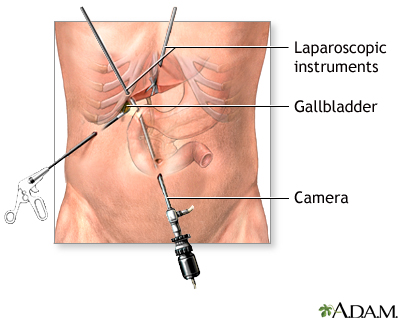
The most common way to remove the gallbladder is by using a medical instrument called a laparoscope (laparoscopic cholecystectomy), done through small incisions. Open gallbladder surgery is used when laparoscopic surgery cannot be done safely. In some cases, the surgeon needs to switch to an open surgery if laparoscopic surgery cannot be successfully continued.
Laparoscopic cholecystectomy
Laparoscopic gallbladder removal is surgery to remove the gallbladder using a medical device called a laparoscope. The gallbladder is an organ that s...

Other reasons for removing the gallbladder by open surgery:
- Unexpected bleeding during the laparoscopic operation
- Obesity
Obesity
Obesity means weighing more than what is healthy for a given height. Obesity is a serious, chronic disease. It can lead to other health problems, i...
 ImageRead Article Now Book Mark Article
 - Inflammation of the pancreas (pancreatitis)
- Pregnancy (third trimester)
- Severe liver problems
Liver problems
The term "liver disease" applies to many conditions that stop the liver from working or prevent it from functioning well. Abdominal pain or swelling...
 ImageRead Article Now Book Mark Article
 - Past surgeries in the same area of your belly
- Severe inflammation of the gallbladder
Risks
Risks of anesthesia and surgery in general are:
- Reactions to medicines
- Breathing problems
Breathing problems
Breathing difficulty may involve:Difficult breathing Uncomfortable breathingFeeling like you are not getting enough air
 ImageRead Article Now Book Mark Article
 - Bleeding, blood clots
Blood clots
Blood clots are clumps that occur when blood hardens from a liquid to a solid. A blood clot that forms inside one of your veins or arteries is calle...
 ImageRead Article Now Book Mark Article
 - Infection
Risks of gallbladder surgery are:
- Damage to the blood vessels that go to the liver
- Injury to the common bile duct
- Injury to the small or large intestine
- Inflammation of the pancreas
Before the Procedure
Your may have the following tests done before surgery:
- Blood tests (complete blood count, electrolytes, liver and kidney tests)
Complete blood count
A complete blood count (CBC) test measures the following:The number of white blood cells (WBC count)The number of red blood cells (RBC count)The numb...
 ImageRead Article Now Book Mark Article
Electrolytes
The electrolytes - urine test measures specific chemicals called electrolytes in urine. It most often measures the levels of calcium, chloride, pota...
 ImageRead Article Now Book Mark Article
 - Chest x-ray or electrocardiogram (ECG), for some people
Chest x-ray
A chest x-ray is an x-ray of the chest, lungs, heart, large arteries, ribs, and diaphragm.
 ImageRead Article Now Book Mark Article
Electrocardiogram
An electrocardiogram (ECG) is a test that records the electrical activity of the heart.
 ImageRead Article Now Book Mark Article
 - CT scan of the abdomen that shows the liver and the gallbladder
- Ultrasound of the gallbladder
Ultrasound
Ultrasound uses high-frequency sound waves to make images of organs and structures inside the body.
 ImageRead Article Now Book Mark Article
Tell your surgeon or nurse if :
- You are or could be pregnant
- You are taking any medicines, including medicines, drugs, supplements, or herbs you bought without a prescription
- You have been drinking a lot of alcohol, more than 1 or 2 drinks a day
Planning for your surgery:
- If you have diabetes, heart disease, or other medical conditions, your surgeon may ask you to see the provider who treats you for these conditions.
Diabetes
Diabetes is a long-term (chronic) disease in which the body cannot regulate the amount of sugar in the blood.
 ImageRead Article Now Book Mark Article
Heart disease
Coronary heart disease is a narrowing of the blood vessels that supply blood and oxygen to the heart. Coronary heart disease (CHD) is also called co...
 ImageRead Article Now Book Mark Article
 - If you smoke, it's important to cut back or quit. Smoking can slow healing and increase the risk for blood clots . Ask your provider for help quitting smoking.
Smoking can slow healing and increase t...
Quitting smoking and other nicotine products, including e-cigarettes, before surgery can improve your recovery and outcome after surgery. Most people...
 ImageRead Article Now Book Mark Article
Quitting smoking
There are many ways to quit smoking. There are also resources to help you. Family members, friends, and co-workers may be supportive. But to be su...
ImageRead Article Now Book Mark Article - If needed, prepare your home to make it easier to recover after surgery.
Prepare your home
Getting your home ready after you have been in the hospital often requires some preparation. Set up your home to make your life easier and safer when...
Read Article Now Book Mark Article - Ask your surgeon if you need to arrange to have someone drive you home after your surgery.
During the week before your surgery:
- You may be asked to stop taking medicines that keep your blood from clotting. These medicines are called blood thinners. This includes over-the-counter medicines and supplements such as aspirin, ibuprofen (Advil, Motrin), naproxen (Aleve, Naprosyn), and vitamin E. Many prescription medicines are also blood thinners.
- Ask your surgeon which medicines you should still take on the day of your surgery.
- Prepare your home for any problems you might have getting around after the surgery.
- Let your surgeon know about any illness you may have before your surgery. This includes COVID-19, a cold, flu, fever, herpes outbreak, or other illness. If you do get sick, your surgery may need to be postponed.
COVID-19
Coronavirus disease 2019 (COVID-19) is a respiratory illness that causes fever, coughing, and shortness of breath, but many other symptoms can occur....
 ImageRead Article Now Book Mark Article
A cold
The common cold most often causes a runny nose, nasal congestion, and sneezing. You may also have a sore throat, cough, headache, or other symptoms....
 ImageRead Article Now Book Mark Article
Flu
The flu (influenza) is a viral respiratory illness that causes fever, chills, runny nose, body aches, and cough. It spreads easily from person to pe...
 ImageRead Article Now Book Mark Article
On the day of surgery:
- Follow instructions about when to stop eating and drinking.
- Take the medicines your surgeon told you to take with a small sip of water.
- Shower the night before or the morning of your surgery.
- Follow instructions on when to arrive at the hospital. Be sure to arrive on time.
After the Procedure
You may need to stay in the hospital for 2 or more days after open gallbladder removal. During that time:
- You may be asked to breathe into a device called an incentive spirometer. This helps keep your lungs working well so that you do not get pneumonia.
- Your nurse will help you sit up in bed, hang your legs over the side, and then stand up and start to walk.
- At first, you will receive fluids into your vein through an intravenous (IV) tube. Soon after, you will be asked to start drinking liquids. Eating solid foods may be delayed.
- You won't be able to shower right away while you are still in the hospital. Your care team will tell you when to begin.
- You may be asked to wear pressure stockings on your legs to help prevent a blood clot from forming.
Pressure stockings
You wear compression stockings to improve blood flow in the veins of your legs. Compression stockings gently squeeze your legs to move blood up your...
 ImageRead Article Now Book Mark Article
If there were problems during your surgery, or if you have bleeding, a lot of pain, or a fever, you may need to stay in the hospital longer. Your surgeon or nurses will tell you how to care for yourself after you leave the hospital.
How to care for yourself
Open gallbladder removal is surgery to remove the gallbladder through a large cut in your abdomen.
Outlook (Prognosis)
Most people have good results from this procedure. It will take several weeks to heal from the open incision and to regain your usual energy.
References
Bonds M, Rocha F. Cholecystectomy techniques and postoperative problems. In: Jarnagin WR, Allen PJ, Chapman WC, et al, eds. Blumgart's Surgery of the Liver, Biliary Tract, and Pancreas. 7th ed. Philadelphia, PA: Elsevier; 2023:chap 36.
Radkani P, Hawksworth J, Fishbein T. Biliary system. In: Townsend CM Jr, Beauchamp RD, Evers BM, Mattox KL, eds. Sabiston Textbook of Surgery. 21st ed. St Louis, MO: Elsevier; 2022:chap 55.
Cholecystitis, CT scan - illustration
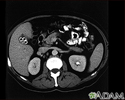
This is a CT scan of the upper abdomen showing cholecystitis (gall stones).
Cholecystitis, CT scan
illustration
Cholecystitis - cholangiogram - illustration
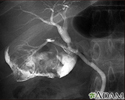
Cholelithiasis can be seen on a cholangiogram. Radio-opaque dye is used to enhance the x-ray. Multiple stones are present in the gallbladder (PTCA).
Cholecystitis - cholangiogram
illustration
Cholecystolithiasis - illustration
Cholecystolithiasis. CT scan of the upper abdomen showing multiple gallstones.
Cholecystolithiasis
illustration
Gallbladder - illustration
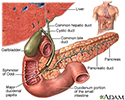
The gallbladder is a muscular sac located under the liver. It stores and concentrates the bile produced in the liver that is not immediately needed for digestion. Bile is released from the gallbladder into the small intestine in response to food. The pancreatic duct joins the common bile duct at the small intestine adding enzymes to aid in digestion.
Gallbladder
illustration
Gallbladder removal - Series
Presentation
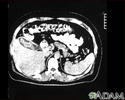
Cholecystitis, CT scan - illustration
This is a CT scan of the upper abdomen showing cholecystitis (gall stones).
Cholecystitis, CT scan
illustration
Cholecystitis - cholangiogram - illustration
Cholelithiasis can be seen on a cholangiogram. Radio-opaque dye is used to enhance the x-ray. Multiple stones are present in the gallbladder (PTCA).
Cholecystitis - cholangiogram
illustration
Cholecystolithiasis - illustration
Cholecystolithiasis. CT scan of the upper abdomen showing multiple gallstones.
Cholecystolithiasis
illustration
Gallbladder - illustration
The gallbladder is a muscular sac located under the liver. It stores and concentrates the bile produced in the liver that is not immediately needed for digestion. Bile is released from the gallbladder into the small intestine in response to food. The pancreatic duct joins the common bile duct at the small intestine adding enzymes to aid in digestion.
Gallbladder
illustration
Gallbladder removal - Series
Presentation
Review Date: 7/9/2025
Reviewed By: John Meilahn, MD, General Surgeon, Wyndmoor, PA. Review provided by VeriMed Healthcare Network. Also reviewed by David C. Dugdale, MD, Medical Director, Brenda Conaway, Editorial Director, and the A.D.A.M. Editorial team.
 All rights reserved.