


Adrenocortical carcinoma
Tumor - adrenal; ACC - adrenalAdrenocortical carcinoma (ACC) is a cancer of the adrenal glands. The adrenal glands are two triangle-shaped glands. One gland is located on top of each kidney.
Adrenal glands
The adrenal glands are two small triangle-shaped glands in the upper abdomen. One gland is located on top of each kidney.

Causes
ACC is most common in children younger than 5 years old and adults in their 40s and 50s.
The condition may be linked to a cancer syndrome that is passed down through families (inherited). Both men and women can develop this tumor.
ACC can produce the hormones cortisol, aldosterone, estrogen, or testosterone, as well as other hormones. In women the tumor often releases these hormones, which can lead to male characteristics.
ACC is very rare. The cause is unknown.
Symptoms
Symptoms of increased cortisol or other adrenal gland hormones may include:
- Fatty, rounded hump high on the back just below the neck (buffalo hump)
Buffalo hump
A hump on the upper back between the shoulder blades is an area of fat accumulation on the back of the neck. The medical name of this condition is d...
Read Article Now Book Mark Article - Flushed, rounded face with pudgy cheeks (moon face)
Moon face
Facial swelling is the buildup of fluid in the tissues of the face. Swelling may also affect the neck and upper arms.
 ImageRead Article Now Book Mark Article
 - Obesity
- Stunted growth (short stature)
Short stature
A child who has short stature is much shorter than children who are the same age and sex. Your health care provider will go over your child's growth ...
 ImageRead Article Now Book Mark Article
 - Virilization -- the appearance of male characteristics, including increased body hair (especially on the face), pubic hair, acne, deepening of the voice, and enlarged clitoris (females)
Virilization
Virilization is a condition in which a female develops characteristics associated with male hormones (androgens), or when a newborn has characteristi...
 ImageRead Article Now Book Mark Article
Symptoms of increased aldosterone are the same as symptoms of low potassium, and include:
- Muscle cramps
- Weakness
- Pain in the abdomen
Exams and Tests
Your health care provider will perform a physical exam and ask about your symptoms.
Blood tests will be done to check hormone levels:
- ACTH level will be low.
ACTH
The ACTH test measures the level of adrenocorticotropic hormone (ACTH) in the blood. ACTH is a hormone released from the pituitary gland at the base...
ImageRead Article Now Book Mark Article - Aldosterone level will be high.
Aldosterone
The aldosterone blood test measures the level of the hormone aldosterone in blood. Aldosterone can also be measured using a urine test.
Read Article Now Book Mark Article - Cortisol level will be high.
Cortisol
The cortisol blood test measures the level of cortisol in the blood. Cortisol is a steroid (glucocorticoid or corticosteroid) hormone produced by th...
 ImageRead Article Now Book Mark Article
 - Potassium level will be low.
Potassium
This test measures the amount of potassium in the fluid portion (serum) of the blood. Potassium (K+) helps nerves and muscles communicate. It also ...
ImageRead Article Now Book Mark Article - Male or female hormones may be abnormally high.
Imaging tests of the abdomen may include:
- Ultrasound
Ultrasound
Abdominal ultrasound is a type of imaging test. It is used to look at organs in the abdomen, including the liver, gallbladder, pancreas, and kidneys...
 ImageRead Article Now Book Mark Article
 - CT scan
CT scan
An abdominal CT scan is an imaging test that uses x-rays to create cross-sectional pictures of the belly area. CT stands for computed tomography....
 ImageRead Article Now Book Mark Article
 - MRI
MRI
A magnetic resonance imaging (MRI) scan is an imaging test that uses powerful magnets and radio waves to create pictures of the body. It does not us...
 ImageRead Article Now Book Mark Article
 - PET scan
PET scan
A positron emission tomography (PET) scan is a type of imaging test. It uses a radioactive substance called a tracer to look for disease in the body...
Read Article Now Book Mark Article
Treatment
The primary treatment is surgery to remove the tumor. ACC may not improve with chemotherapy. Medicines may be given to reduce production of cortisol, which causes many of the symptoms.
Chemotherapy
The term chemotherapy is used to describe cancer-killing drugs. Chemotherapy may be used to:Cure the cancerShrink the cancerPrevent the cancer from ...

Outlook (Prognosis)
The outcome depends on how early the diagnosis is made and whether the tumor has spread (metastasized). Tumors that have spread usually lead to death within 1 to 3 years.
Possible Complications
The tumor can spread to the liver, bone, lung, or other areas.
When to Contact a Medical Professional
Contact your provider if you or your child has symptoms of ACC, Cushing syndrome, or failure to grow.
Cushing syndrome
Cushing syndrome is a disorder that occurs when your body has a high level of the hormone cortisol.
References
Habra M, Else T, Fassnacht M. Adrenocortical carcinoma. In: Robertson RP, ed. DeGroot's Endocrinology. 8th ed. Philadelphia, PA: Elsevier; 2023:chap 98.
National Cancer Institute website. Adrenocortical carcinoma treatment (PDQ) - health professional version. www.cancer.gov/types/adrenocortical/hp/adrenocortical-treatment-pdq. Updated August 25, 2022. Accessed August 27, 2024.
Yeh MW, Livhits M, Duh Q-Y. The adrenal glands. In: Townsend CM Jr, Beauchamp RD, Evers BM, Mattox KL, et al, eds. Sabiston Textbook of Surgery. 21st ed. St Louis, MO: Elsevier; 2022:chap 40.
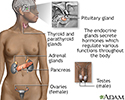
Endocrine glands - illustration
Endocrine glands release hormones (chemical messengers) into the bloodstream to be transported to various organs and tissues throughout the body. For instance, the pancreas secretes insulin, which allows the body to regulate levels of sugar in the blood. The thyroid gets instructions from the pituitary to secrete hormones which determine the rate of metabolism in the body (the more hormone in the bloodstream, the faster the chemical activity; the less hormone, the slower the activity).
Endocrine glands
illustration
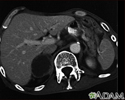
Adrenal metastases - CT scan - illustration
This CT scan of the upper abdomen shows an adrenal metastasis (spreading of a tumor to the adrenal gland, above the kidney) in a person with lung cancer.
Adrenal metastases - CT scan
illustration
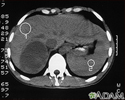
Adrenal Tumor - CT - illustration
CT scan of the upper abdomen in a person with a right adrenal mass. The adrenal glands are located above the kidneys.
Adrenal Tumor - CT
illustration
Endocrine glands - illustration
Endocrine glands release hormones (chemical messengers) into the bloodstream to be transported to various organs and tissues throughout the body. For instance, the pancreas secretes insulin, which allows the body to regulate levels of sugar in the blood. The thyroid gets instructions from the pituitary to secrete hormones which determine the rate of metabolism in the body (the more hormone in the bloodstream, the faster the chemical activity; the less hormone, the slower the activity).
Endocrine glands
illustration
Adrenal metastases - CT scan - illustration
This CT scan of the upper abdomen shows an adrenal metastasis (spreading of a tumor to the adrenal gland, above the kidney) in a person with lung cancer.
Adrenal metastases - CT scan
illustration
Adrenal Tumor - CT - illustration
CT scan of the upper abdomen in a person with a right adrenal mass. The adrenal glands are located above the kidneys.
Adrenal Tumor - CT
illustration
Review Date: 8/21/2024
Reviewed By: Warren Brenner, MD, Oncologist, Lynn Cancer Institute, Boca Raton, FL. Review provided by VeriMed Healthcare Network. Also reviewed by David C. Dugdale, MD, Medical Director, Brenda Conaway, Editorial Director, and the A.D.A.M. Editorial team.
© 1997- A.D.A.M., a business unit of Ebix, Inc. Any duplication or distribution of the information contained herein is strictly prohibited.
 All rights reserved.