


Dermal melanocytosis
Mongolian spots; Congenital dermal melanocytosisDermal melanocytosis is the name of a kind of birthmark that is flat and blue, or blue-gray in color. They appear at birth or in the first few weeks of life. Dermal melanocytosis was formerly called Mongolian blue spots.
Birthmark
A birthmark is a skin marking that is present at birth. Birthmarks include cafe-au-lait spots, moles, and Mongolian spots. Birthmarks can be red or...

Causes
Dermal melanocytosis is common among people of Asian, Native American, Hispanic, East Indian, and African descent.
The color of the birth mark is from a collection of melanocytes in the deeper layers of the skin. Melanocytes are cells that make the pigment (color) in the skin.
Symptoms
Dermal melanocytosis is not cancerous and is not associated with disease. The markings may cover a large area of the back.
The markings are usually:
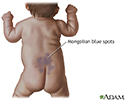
- Blue or blue-gray spots on the back, buttocks, base of spine, shoulders, or other body areas
- Flat with irregular shape and unclear edges
- Normal in skin texture
- 0.79 to 3.15 inches (in) or 2 to 8 centimeters (cm) wide or larger
Dermal melanocytosis is sometimes mistaken for bruises. This can raise a question about possible child abuse. It is important to recognize that dermal melanocytosis is a birthmark, not bruises.
Bruises
A bruise is an area of skin discoloration. A bruise occurs when small blood vessels break and leak their contents into the soft tissue beneath the s...

Exams and Tests
No tests are needed. Your health care provider can diagnose this condition by looking at the skin.
If your provider suspects an underlying disorder, further tests will be done.
Treatment
No treatment is needed when dermal melanocytosis is a normal birthmark. If treatment is needed, lasers may be used.
Spots may be a sign of an underlying disorder. If so, treatment for that problem will likely be recommended. Your provider can tell you more.
Outlook (Prognosis)
Spots that are normal birthmarks often fade in a few years. They are almost always gone by the teen years.
When to Contact a Medical Professional
All birthmarks should be examined by a provider during the routine newborn examination.
References
James WD. Melanocytic nevi and neoplasms. In: James WD, ed. Andrews' Diseases of the Skin: Clinical Dermatology. 14th ed. Philadelphia, PA: Elsevier; 2026:chap 25.
Martin KL. Cutaneous nevi. In: Kliegman RM, St. Geme JW, Blum NJ, et al, eds. Nelson Textbook of Pediatrics. 22nd ed. Philadelphia, PA: Elsevier; 2025:chap 692.
Mongolian blue spots - illustration
Mongolian blue spots are flat bluish- to bluish-gray skin markings commonly appearing at birth or shortly thereafter. They appear commonly at the base of the spine, on the buttocks and back and also can appear on the shoulders. Mongolian spots are benign and are not associated with any conditions or illnesses.
Mongolian blue spots
illustration
Neonate - illustration
A newly born infant is also called a neonate.
Neonate
illustration
Mongolian blue spots - illustration
Mongolian blue spots are flat bluish- to bluish-gray skin markings commonly appearing at birth or shortly thereafter. They appear commonly at the base of the spine, on the buttocks and back and also can appear on the shoulders. Mongolian spots are benign and are not associated with any conditions or illnesses.
Mongolian blue spots
illustration
Neonate - illustration
A newly born infant is also called a neonate.
Neonate
illustration
Review Date: 6/3/2025
Reviewed By: Ramin Fathi, MD, FAAD, Director, Phoenix Surgical Dermatology Group, Phoenix, AZ. Also reviewed by David C. Dugdale, MD, Medical Director, Brenda Conaway, Editorial Director, and the A.D.A.M. Editorial team.
© 1997- A.D.A.M., a business unit of Ebix, Inc. Any duplication or distribution of the information contained herein is strictly prohibited.
 All rights reserved.