


Erythema nodosum
Erythema nodosum is an inflammatory disorder. It involves tender, red bumps (nodules) under the skin.
Nodules
Skin nodules are solid or cystic raised bumps in the skin that are wider than 0. 39 inches (in) or 1 centimeter (cm), but less than 0. 79 in (2 cm). ...

Causes
In about half of cases, the exact cause of erythema nodosum is unknown. The remaining cases are associated with an infection or other systemic disorder.
Some of the more common infections associated with the disorder are:
- Streptococcus (most common)
- Cat scratch disease
Cat scratch disease
Cat-scratch disease is an infection with bartonella bacteria. It may be transmitted by cat scratches, cat bites, or flea bites.
 ImageRead Article Now Book Mark Article
 - Chlamydia
Chlamydia
Chlamydia is an infection caused by the bacteria Chlamydia trachomatis. It is most often spread through sexual contact.
 ImageRead Article Now Book Mark Article
 - Coccidioidomycosis
Coccidioidomycosis
Valley fever is an infection that occurs when the spores of the fungus Coccidioides immitis or Coccidioides posadasii enter your body through the lun...
 ImageRead Article Now Book Mark Article
 - Hepatitis B
Hepatitis B
Hepatitis B is irritation and swelling (inflammation) of the liver due to infection with the hepatitis B virus (HBV). Other types of viral hepatitis ...
 ImageRead Article Now Book Mark Article
 - Histoplasmosis
Histoplasmosis
Histoplasmosis is an infection that occurs from breathing in the spores of the fungus Histoplasma capsulatum.
 ImageRead Article Now Book Mark Article
 - Leptospirosis
Leptospirosis
Leptospirosis is an infection caused by leptospira bacteria.
ImageRead Article Now Book Mark Article - Mononucleosis (EBV)
Mononucleosis
Mononucleosis, or mono, is a viral infection that causes fever, sore throat, and swollen lymph glands, most often in the neck.
 ImageRead Article Now Book Mark Article
 - Mycobacteria
- Mycoplasma
- Psittacosis
Psittacosis
Psittacosis is an infection caused by Chlamydia psittaci, a type of bacteria found in the droppings of birds. Birds spread the infection to humans....
ImageRead Article Now Book Mark Article - Syphilis
Syphilis
Syphilis is a bacterial infection that is most often spread through sexual contact.
 ImageRead Article Now Book Mark Article
 - Tuberculosis
Tuberculosis
Pulmonary tuberculosis (TB) is a contagious bacterial infection that involves the lungs. It may spread to other organs.
 ImageRead Article Now Book Mark Article
 - Tularemia
Tularemia
Tularemia is a bacterial infection in wild rodents. The bacteria are passed to humans through contact with tissue from the infected animal. The bac...
 ImageRead Article Now Book Mark Article
 - Yersinia
Erythema nodosum may occur with sensitivity to certain medicines, including:
- Antibiotics, including amoxicillin and other penicillins
- Sulfonamides
- Sulfones
- Birth control pills
- Progestin
Sometimes, erythema nodosum may occur during pregnancy.
Other disorders linked to this condition include leukemia, lymphoma, sarcoidosis, rheumatic fever, Behcet disease, and ulcerative colitis.
Leukemia
Leukemia is a type of blood cancer that begins in the bone marrow. Bone marrow is the soft tissue in the center of the bones, where blood cells are ...

Sarcoidosis
Sarcoidosis is a disease in which inflammation occurs in the lymph nodes, lungs, liver, eyes, skin, and other tissues.

Rheumatic fever
Rheumatic fever is a disease that may develop after an infection with group A streptococcus bacteria (such as strep throat or scarlet fever). It can...
Ulcerative colitis
Ulcerative colitis is a condition in which the lining of the large intestine (colon) and rectum become inflamed. It is a form of inflammatory bowel ...

The condition is more common in women than it is in men.
Symptoms
Erythema nodosum is most common on the front of the shins. It may also occur on other areas of the body such as the buttocks, calves, ankles, thighs, and arms.
The lesions begin as flat, firm, hot, red, painful lumps that are about 1 inch (in) or 2.5 centimeters (cm) across. Within a few days, they may become purplish in color. Over several weeks, the lumps fade to a brownish, flat patch.
Other symptoms may include:
- Fever
- General ill feeling (malaise)
- Joint aches
- Skin redness, inflammation, or irritation
- Swelling of the leg or other affected area
Exams and Tests
Your health care provider can diagnose this condition by looking at your skin. Tests that may be done include:
- Punch biopsy of a nodule
Punch biopsy
A skin lesion biopsy is when a small amount of skin is removed so it can be examined under a microscope. The skin is tested to look for skin conditi...
 ImageRead Article Now Book Mark Article
 - Throat culture to check for a strep infection
- Chest x-ray to check for sarcoidosis or tuberculosis
Chest x-ray
A chest x-ray is an x-ray of the chest, lungs, heart, large arteries, ribs, and diaphragm.
 ImageRead Article Now Book Mark Article
 - Blood tests to look for infections or other disorders
Treatment
The underlying infection, medicine, or disease should be identified and treated.
Treatment may include:
- Nonsteroidal anti-inflammatory drugs (NSAIDs).
- Stronger anti-inflammatory medicines called corticosteroids, taken by mouth or given as a shot.
- Potassium iodide (SSKI) solution, most often given as drops added to orange juice.
- Other oral medicines that work on the body's immune system.
- Pain medicines (analgesics).
- Rest.
- Raising the sore area (elevation).
- Hot or cold compresses to help reduce discomfort.
Outlook (Prognosis)
Erythema nodosum is uncomfortable, but not dangerous in most cases.
Symptoms most often go away within about 6 weeks, but may return.
When to Contact a Medical Professional
Contact your provider if you develop symptoms of erythema nodosum.
References
James WD. Diseases of the subcutaneous fat. In: James WD, ed. Andrews' Diseases of the Skin: Clinical Dermatology. 14th ed. Philadelphia, PA: Elsevier; 2026:chap 18.
Korsten P, Sweiss NJ, Baughman RP. Sarcoidosis. In: Firestein GS, McInnes IB, Koretzky GA, Milkuls TR, Neogi T, O'Dell JR, eds. Firestein & Kelley's Textbook of Rheumatology. 12th ed. Philadelphia, PA: Elsevier; 2025:chap 122.
Kuhn KA, Bewtra M, Mayer A, Ogdie A. Inflammatory bowel disease-associated arthritis and other enteropathic arthropathies. In: Firestein GS, McInnes IB, Koretzky GA, Milkuls TR, Neogi T, O'Dell JR, eds. Firestein & Kelley's Textbook of Rheumatology. 12th ed. Philadelphia, PA: Elsevier; 2025:chap 79.
Moon M, Guerrero AM, Li X, Koch E, Gehris RP. Dermatology. In: Zitelli BJ, McIntire SC, Nowalk AJ, Garrison J, eds. Zitelli and Davis' Atlas of Pediatric Diagnosis. 8th ed. Philadelphia, PA: Elsevier; 2023:chap 8.
Shields BE, Forrestel A, Rosenbach M. Erythema nodosum. In: Lebwohl MG, Heymann WR, Coulson IH, Murrell DF, eds. Treatment of Skin Disease: Comprehensive Therapeutic Strategies. 6th ed. Philadelphia, PA: Elsevier; 2022:chap 76.
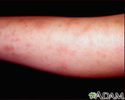
Erythema nodosum associated with sarcoidosis - illustration
This picture shows reddish-purple, hard (indurated), painful nodules (erythema nodosum) that occur most commonly on the shins. These lesions may be anywhere on the body and may be associated with tuberculosis (TB), sarcoidosis, coccidioidomycosis, systemic lupus erythematosis (SLE), fungal infections, or in response to medications.
Erythema nodosum associated with sarcoidosis
illustration
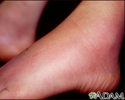
Erythema nodosum on the foot - illustration
This person has erythema nodosum nodules on the feet. The feet are red and painful. This disorder may be associated with drugs or infections.
Erythema nodosum on the foot
illustration
Erythema nodosum associated with sarcoidosis - illustration
This picture shows reddish-purple, hard (indurated), painful nodules (erythema nodosum) that occur most commonly on the shins. These lesions may be anywhere on the body and may be associated with tuberculosis (TB), sarcoidosis, coccidioidomycosis, systemic lupus erythematosis (SLE), fungal infections, or in response to medications.
Erythema nodosum associated with sarcoidosis
illustration
Erythema nodosum on the foot - illustration
This person has erythema nodosum nodules on the feet. The feet are red and painful. This disorder may be associated with drugs or infections.
Erythema nodosum on the foot
illustration
Review Date: 8/2/2025
Reviewed By: Ramin Fathi, MD, FAAD, Director, Phoenix Surgical Dermatology Group, Phoenix, AZ. Also reviewed by David C. Dugdale, MD, Medical Director, Brenda Conaway, Editorial Director, and the A.D.A.M. Editorial team.
 All rights reserved.