


Brain tumor - children
Glioblastoma multiforme - children; Ependymoma - children; Glioma - children; Astrocytoma - children; Medulloblastoma - children; Neuroglioma - children; Oligodendroglioma - children; Meningioma - children; Cancer - brain tumor (children)A brain tumor is a group (mass) of abnormal cells that grow in the brain.
This article focuses on primary brain tumors in children.
Causes
The cause of primary brain tumors is often unknown. Some primary brain tumors are related to other syndromes or can run in a family. They can be:
- Not cancerous (benign)
Benign
Benign refers to a condition, tumor, or growth that is not cancerous. This means that it does not spread to other parts of the body. It does not in...
 ImageRead Article Now Book Mark Article
 - Invasive (spread to nearby areas)
- Cancerous (malignant)
Brain tumors are classified based on:
- The exact site of the tumor
- The type of tissue involved
- Whether it is cancerous
Brain tumors can directly kill brain cells. They can also damage cells by pushing on other parts of the brain. This leads to swelling and increased pressure inside the skull.
Tumors can occur at any age. Many tumors are more common at a certain age. In general, brain tumors in children are very rare.
COMMON TUMOR TYPES
Astrocytomas are usually noncancerous, slow-growing tumors. They most often develop in children ages 5 to 8. Also called low-grade gliomas, these are the most common brain tumors in children.
Medulloblastomas are the most common type of childhood brain cancer. Most medulloblastomas occur before age 10.
Ependymomas are a type of childhood brain tumor that can be benign or malignant. Therapy to control the tumor is based on the location and type of ependymoma.
Brainstem gliomas are very rare tumors that occur almost only in children. The average age at which they develop in children is about age 6.
Symptoms
Symptoms may be subtle and slowly become worse, or they may occur very quickly.
Headaches are often the most common symptom. But only very rarely do children with headaches have a brain tumor. Headache patterns that may occur with brain tumors include:
- Headaches that are worse when waking up in the morning and go away within a few hours
- Headaches that get worse with coughing or exercise, or with a change in body position
- Headaches that occur while sleeping and with at least one other symptom such as vomiting or confusion
Sometimes, the only symptoms of brain tumors are mental changes, which may include:
- Changes in personality and behavior
- Unable to concentrate
- Increased sleep
- Memory loss
- Problems with reasoning
Other possible symptoms are:
- Seizures
Seizures
A seizure is the physical changes in behavior that occurs during an episode of specific types of abnormal electrical activity in the brain. The term ...
 ImageRead Article Now Book Mark Article
 - Unexplained frequent vomiting
- Gradual loss of movement or feeling in an arm or leg
- Hearing loss with or without dizziness
Dizziness
Dizziness is a term that is often used to describe 2 different symptoms: lightheadedness and vertigo. Lightheadedness is a feeling that you might fai...
 ImageRead Article Now Book Mark Article
 - Speech difficulty
Speech difficulty
A speech disorder is a condition in which a person has problems creating or forming the speech sounds needed to communicate with others. This can ma...
Read Article Now Book Mark Article - Unexpected vision problem (if it occurs with a headache), including vision loss (peripheral vision) in one or both eyes, or double vision
- Problems with balance
- Weakness or numbness in part of the body
Numbness
Numbness and tingling are abnormal sensations that can occur anywhere in your body, but they are often felt in your fingers, hands, feet, arms, or le...
 ImageRead Article Now Book Mark Article
Exams and Tests
Your child's health care provider will perform a physical exam. Infants may have the following physical signs:
- Bulging fontanelle
Bulging fontanelle
A bulging fontanelle is an outward curving of an infant's soft spot (fontanelle).
 ImageRead Article Now Book Mark Article
 - Enlarged eyes
- No red reflex in the eye
- Abnormal reflexes
Abnormal reflexes
Reflexes are responses that occur when the body receives a certain stimulus. The Babinski reflex occurs after the sole of the foot has been firmly s...
Read Article Now Book Mark Article - Separated sutures of the skull bones
Older children with brain tumors may have the following physical signs or symptoms:
- Headache
- Vomiting
- Vision changes
Vision changes
There are many types of eye problems and vision disturbances, such as: Halos Blurred vision (the loss of sharpness of vision and the inability to see...
 ImageRead Article Now Book Mark Article
 - Change how the child walks (gait)
Gait
Walking abnormalities can be caused by many different types of problems. Problems with the joints, (such as arthritis), bones (such as deformities),...
 ImageRead Article Now Book Mark Article
 - Weakness or numbness of a specific body part
- Head tilt
The following tests may be used to detect a brain tumor and identify its location:
- CT scan of the head
CT scan of the head
A head computed tomography (CT) scan uses many x-rays to create pictures of the head, including the skull, brain, eye sockets, and sinuses.
 ImageRead Article Now Book Mark Article
 - MRI of the brain
MRI of the brain
A head MRI (magnetic resonance imaging) is an imaging test that uses powerful magnets and radio waves to create pictures of the brain and surrounding...
 ImageRead Article Now Book Mark Article
 - Examination of the cerebral spinal fluid (CSF)
Examination of the cerebral spinal flui
Cerebrospinal fluid (CSF) analysis is a group of lab tests that measure chemicals in the cerebrospinal fluid. CSF is a clear fluid that surrounds an...
 ImageRead Article Now Book Mark Article
Treatment
The treatment depends on the size and type of tumor and the child's general health. The goals of treatment may be to cure the tumor, relieve symptoms, and improve brain function or the child's comfort.
Surgery is needed for most primary brain tumors. Some tumors may be completely removed. In cases where the tumor can't be removed, surgery may help reduce pressure and relieve symptoms. Chemotherapy or radiation therapy may be used for certain tumors.
Chemotherapy
The term chemotherapy is used to describe cancer-killing drugs. Chemotherapy may be used to:Cure the cancerShrink the cancerPrevent the cancer from ...

Radiation therapy
Radiation therapy uses high-powered radiation (such as x-rays or gamma rays), particles, or radioactive seeds to kill cancer cells.

The following are treatments for specific types of tumors:
- Astrocytoma: Surgery to remove the tumor is the main treatment. Chemotherapy or radiation therapy may also be needed.
- Brainstem gliomas: Surgery may not be possible because of the tumor's location deep in the brain. Radiation is used to shrink the tumor and prolong life. Sometimes targeted chemotherapy can be used.
Targeted chemotherapy
Targeted therapy uses medicines to stop cancer from growing and spreading. It does this with less harm to normal cells than other treatments. Stand...
Read Article Now Book Mark Article - Ependymomas: Treatment includes surgery. Radiation and chemotherapy may be necessary.
- Medulloblastomas: Surgery alone does not cure this type of tumor. Chemotherapy with or without radiation is often used in combination with surgery.
Medicines used to treat children with primary brain tumors include:
- Corticosteroids to reduce brain swelling
- Diuretics (water pills) to reduce brain swelling and pressure
- Anticonvulsants to reduce or prevent seizures
- Pain medicines
- Chemotherapy to help shrink the tumor or prevent the tumor from growing back
Comfort measures, safety measures, physical therapy, occupational therapy, and other such steps may be required to improve quality of life.
Support Groups
You can ease the stress of illness by joining a cancer support group. Sharing with others who have common experiences and problems can help you and your child feel less alone.
Cancer support group
The following organizations are good resources for information on cancer:American Cancer Society. Support and online communities. www. cancer. org/...
Outlook (Prognosis)
How well a child does depends on many things, including the type of tumor. In general, about 3 out of 4 children survive at least 5 years after being diagnosed.
Long-term brain and nervous system problems may result from the tumor itself or from its treatment. Children may have problems with attention, focus, or memory. They may also have problems processing information, planning, insight, or initiative or desire to do things.
Children younger than age 7, especially younger than age 3, seem to be at greatest risk of these complications.
Parents need to make sure that children receive support services at home and at school.
When to Contact a Medical Professional
Contact a provider if a child develops headaches that do not go away or other symptoms of a brain tumor.
Go to the emergency room if a child develops any of the following:
- Physical weakness
- Change in behavior
- Severe headache of unknown cause
- Seizure of unknown cause
- Vision changes
- Speech changes
References
National Cancer Institute website. Childhood brain and spinal cord tumors summary index (PDQ): health professional version. www.cancer.gov/types/brain/hp/child-brain-treatment-pdq. Updated December 19, 2023. Accessed July 29, 2025.
Zaky W. Central nervous system tumors in childhood. In: Kliegman RM, St. Geme JW, Blum NJ, et al, eds. Nelson Textbook of Pediatrics. 22nd ed. Philadelphia, PA: Elsevier; 2025:chap 546.
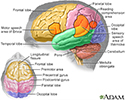
Brain - illustration
The major areas of the brain have one or more specific functions.
Brain
illustration
Primary brain tumor - illustration
A primary brain tumor is a mass created by the growth or uncontrolled proliferation of cells in the brain.
Primary brain tumor
illustration

Review Date: 7/17/2025
Reviewed By: Joseph V. Campellone, MD, Department of Neurology, Cooper Medical School at Rowan University, Camden, NJ. Review provided by VeriMed Healthcare Network. Also reviewed by David C. Dugdale, MD, Medical Director, Brenda Conaway, Editorial Director, and the A.D.A.M. Editorial team.
 All rights reserved.